
















The short answer: A senior dog slowing down on walks can be normal ageing or a sign of joint discomfort. A gradual, steady change is often ageing; a sudden or one-sided change should be checked by your vet. Shorter, more frequent walks at your dog's pace on softer, level ground, plus a consistent daily routine, help keep walks comfortable.
Your dog still trots to the front door when the lead comes out. But somewhere along a familiar route, they start lagging behind, stopping to sniff for longer, or simply sitting down halfway. If your senior dog is slowing down on walks, it is worth paying attention - not because every slower walk is a problem, but because the small adjustments you make now can help keep walks comfortable and enjoyable for much longer.
Why senior dogs slow down on walks
Ageing changes the way a dog moves. Muscle condition gradually reduces, joints feel stiffer after rest, and recovery after exercise takes longer than it used to. For many older dogs, the first thing owners notice is not a limp but a quiet change in pace and enthusiasm - a shorter stride, more time spent sniffing, or a reluctance to keep going on the second half of the usual loop.
It helps to remember that slowing down is not automatically a sign that something is wrong, and it is not automatically "just old age" either. It can reflect normal ageing, or it can reflect joint discomfort that deserves a closer look. The useful question is not whether your dog is slower than before, but whether the change has been gradual and steady or sudden and one-sided.
How to tell normal ageing from joint discomfort
Some clues tend to point towards ordinary ageing. Your dog moves comfortably at the start of a walk but tires towards the end. Their feet land normally, they simply take their time. They rest longer afterwards but recover well. They are slower after long or unusually strenuous outings, and much brighter on easy days.
Other clues are worth mentioning to your vet. These include lagging behind from the very first steps, stiffness when getting up after rest, reluctance to jump into the car or climb stairs, spending long periods lying in one position, or a change in gait such as a shorter stride or an obvious head bob.
If you notice limping, swelling, signs of pain or any sudden change in your dog's mobility, speak to your vet. These are not things to manage at home with guesswork, and a prompt conversation is the kindest first step.
Adjusting walk length, pace and surfaces
Most of the practical work of adapting a daily routine comes down to three things: how far, how fast and where.
Walk shorter, more often. Splitting one long outing into two or three shorter ones often suits stiff joints better than a single long stretch. Many owners find that two relaxed 15-20 minute walks a day suit their dog better than one 40-minute loop.
Let your dog set the pace. Sniffing is enrichment, and a slow, sniff-heavy walk can be just as satisfying for your dog as a brisk one. There is no prize for covering distance.
Choose softer, level surfaces. Grass, dirt tracks and firm even paths are usually kinder than hot pavement, steep hills or long flights of stairs. If your favourite route includes a steep section, look for a flatter alternative and save the hills for days when your dog is moving well.
Warm up and cool down. A few slow minutes at the beginning and end of a walk gives stiff joints time to loosen and settle, rather than moving straight from the couch to a brisk pace.
Watch the weather. Cold mornings and very hot days are harder on older dogs. In summer, walk earlier or later in the day, and check the temperature of the pavement with the back of your hand before setting off.
Small changes that help at home
The routine around the walk matters too. Non-slip mats on hard floors, a ramp instead of a jump in and out of the car, raised food and water bowls, and a supportive, well-padded bed all reduce the everyday strain on a dog whose joints are feeling their age. None of these replace veterinary advice, but together they make daily life easier.
Building a simple daily routine that supports joint comfort
For older dogs, consistency tends to matter more than intensity. A routine that combines appropriate exercise, sensible weight management and daily nutritional support gives your dog the best chance of staying comfortable in the years ahead.
Three habits are worth building: keep meal and walk times regular so your dog knows what to expect; keep your dog at a healthy weight, since extra kilos place extra load on joints and your vet can advise on this; and if you use a joint-support supplement, give it at the same time each day so it becomes part of the routine rather than an afterthought.
Where rosehip powder fits into the daily routine
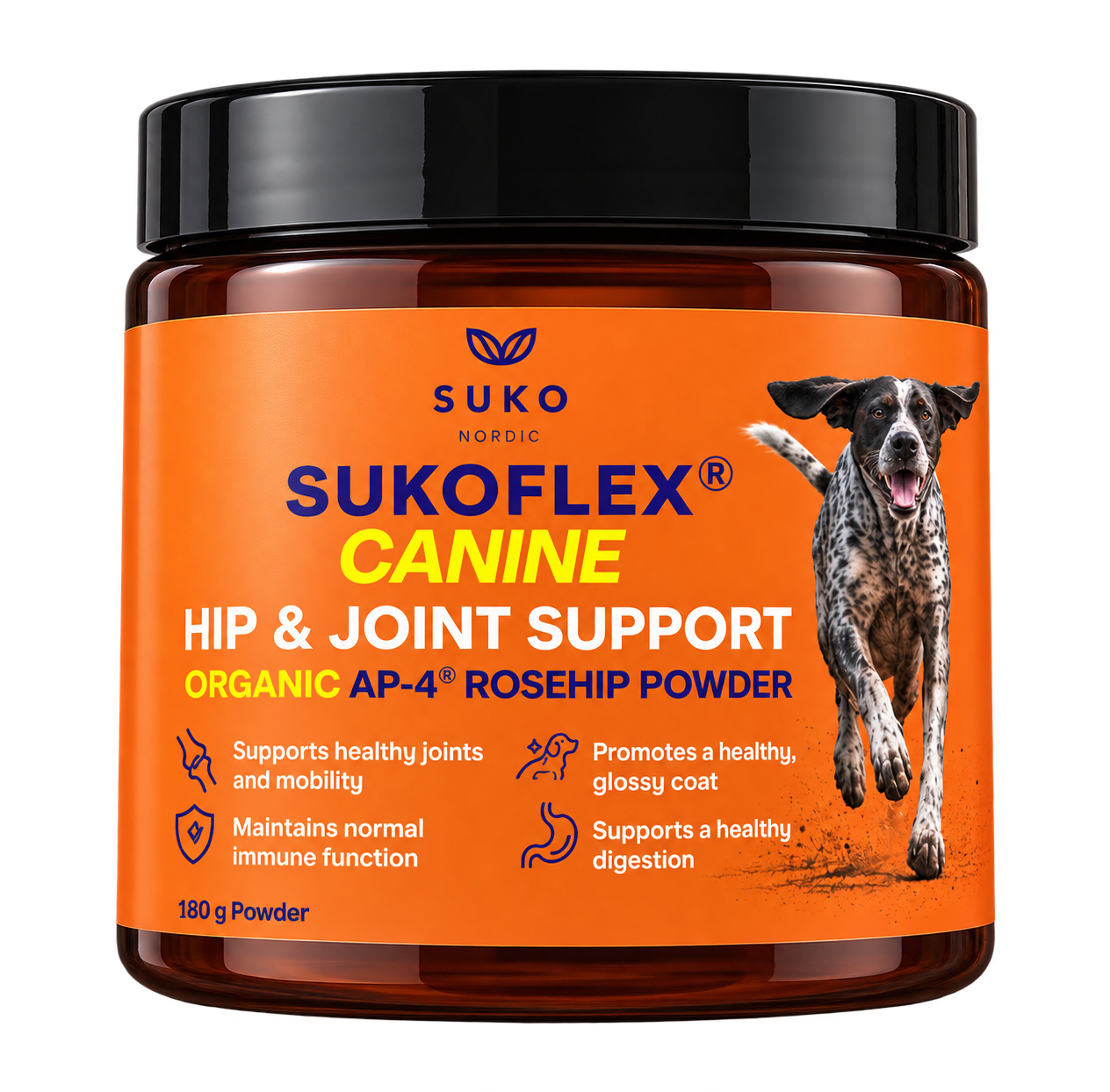
SUKOFLEX® CANINE Organic Rosehip Powder is a single-ingredient supplement made from the same standardised AP-4® rosehip used in SUKOFLEX® for humans. As part of a daily routine it supports joint comfort, healthy joints and mobility in ageing or active dogs, while its natural antioxidants help protect cells from oxidative stress.
Because it comes as a powder, it fits easily into the way you already feed your dog - simply sprinkle the recommended amount over their usual meal (see our dosage guide). One point we like to be clear about: the clinical studies behind AP-4® rosehip were carried out in people, not in dogs. So we describe its place in your dog's routine in supportive terms - daily nutritional support for healthy joints and mobility - rather than as a treatment for any condition.
Not sure whether your dog's changes are more than age? Our guide 7 Signs Your Dog's Joints Need Support lists what to watch for, and Natural Joint Support for Dogs With Arthritis answers common owner questions.
When to speak to your vet
A daily routine can do a great deal, but it works best alongside professional advice. Check with your vet if your dog is limping or lame, if there is swelling, heat or pain when a joint is touched, if mobility changes suddenly rather than gradually, or if your dog seems unwell in other ways such as going off their food. If you are considering adding anything new to your dog's diet, your vet is the right person to ask first.
Key takeaways
- A senior dog slowing down on walks can reflect normal ageing or joint discomfort - look at whether the change has been gradual and steady, or sudden and one-sided.
- Adapt the walk itself: shorter and more frequent outings, a relaxed pace, softer level surfaces, and slow warm-ups and cool-downs.
- Build a consistent daily routine around regular walks, a healthy weight and simple home adjustments such as non-slip flooring and ramps.
- If you use a joint-support supplement such as SUKOFLEX® CANINE rosehip powder, give it at the same time each day over your dog's usual meal.
- Always speak to your vet about limping, swelling, pain or any sudden change in your dog's movement.
Slowing down on walks does not have to mean the end of the walks your dog loves. With a few thoughtful adjustments - a gentler route, a steadier pace and a simple daily routine - you can help your ageing companion stay comfortable and keep enjoying the everyday moments you share together.